


GRADES 4-6
Food Truck Designers

Driving Question:
How can we calculate surface area and volume?
Activity Overview:
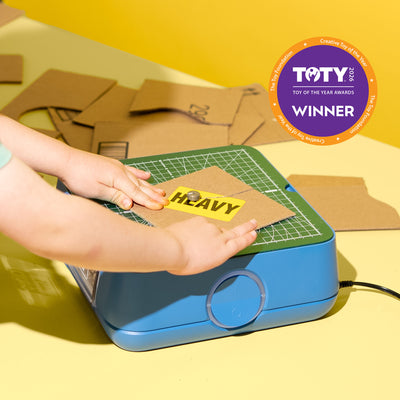
In this lesson, students investigate how 3D shapes, volume, and surface area are used in real-world design, then put that knowledge to work. Students will work in groups to design and build a cardboard food truck using the ChompSaw, measure their finished models, and calculate volume and surface area. The lesson wraps up with a Food Truck Expo where students share their designs and compare their math.
Learning Objectives
- I can identify 3D shapes in a food truck design.
- I can calculate volume.
- I can calculate surface area.
- I can design and build a food truck model.
- I can explain how volume and surface area relate to my design.
Slide Deck


Full Materials List
Vocabulary Slides for frontloading
1 per student
1 per student
1 per student
1 per student
1 per student
Chompsaw(s)
Cardboard
Tape, glue
Rulers
Pencils
Markers/Colored Pencils
Preview/Background Knowledge
- Students should be able to identify common 3D shapes including rectangular prisms, cubes, and cylinders
- Students should have a basic understanding of area and how it is calculated for 2D shapes
- Students should be familiar with multiplication and be able to apply it to multi-step problems
- Students should have an introductory understanding of volume as the amount of space inside a 3D object
- Students should be able to read and use a ruler to measure length in standard units
Prep Instructions
Helpful Teacher Tip
Encourage students to keep their food truck designs relatively simple. A strong rectangular prism-based design allows students to focus on understanding volume and surface area rather than struggling with construction. Remind students that engineers and designers often begin with simple prototypes before creating more complex models.1. Prepare Student Groups
- Divide students into groups of 3–4 students.
- Each group will design and build one food truck together.
2. Print Student Materials
- Print the following materials before class:
- Food Truck Planning Sheet (1 per student)
- Food Truck Expo Worksheet (1 per student)
- Assessment (1 per student)
3. Gather Building Materials
- For each group, prepare:
- 5 large pieces of cardboard
- 1 ChompSaw
- Tape
- Rulers
- Supplies for decorating
4. Review Lesson Timing
- The building and measuring portions require the most time.
- If your schedule is limited:
- Complete the design and building portion during one class period.
- Measure, calculate, and complete the Food Truck Expo during a second class period.
- This allows students to spend more time making accurate measurements and calculations.
Extensions
Food Truck Through Time
- Students redesign their truck for a different time period.
- Example Time Periods
- 1920s
- 2050
- Ancient Rome
- Medieval Times
- Students must:
- explain how customer needs and technology influenced their design
- Example Time Periods
Ultimate Customer Experience Challenge
- Students add features to their truck to improve the customer experience.
- Example Features
- ordering station
- covered waiting area
- menu board
- outdoor seating
- Students must:
- recalculate the volume and surface area affected by their additions
- Example Features
Food Truck Escape Challenge
- Students draw a challenge card and modify their truck to solve it.
- Challenge Cards
- Add 25% more storage space.
- Reduce surface area by 20%.
- Add a second serving window.
- Create a drive-through version.
- Students must:
- sketch and explain how they would modify their truck
- solve the challenge card to "escape!"
- Challenge Cards
Build a Food Truck Festival
- Combine all food trucks into one large classroom food truck park.
- Students must:
- create a map showing where each truck belongs
- explain their placement decisions
- Students must:
Budget Builder Challenge
- Assign costs to materials based on surface area.
- Students must:
- calculate the cost of covering the outside of their food truck
- determine whether they stayed within budget
- Students must: